Reviewed by Letha McDowell, CELA, CAPCertified Elder Law Attorney Letha Sgritta McDowell is a past president of the National Academy of Elder Law Attorneys.
More info
Yes, Medicare covers home health care when it’s medically necessary, ordered by a doctor, and provided by a Medicare-certified agency. Covered services may include skilled nursing, therapies, medical supplies, and short-term personal care to support recovery. Medicare doesn’t cover home care (long-term, nonmedical help with bathing, dressing, mobility, supervision, or household tasks) unless these services are part of a doctor-ordered home health plan that also includes skilled care. Understanding this difference can help you choose the safest, most affordable support for your loved one.
Let our care assessment guide you
Our free tool provides options, advice, and next steps based on your unique situation.
Skilled nursing, rehabilitation therapies, medical supplies, and short-term personal care tied to skilled services
Yes
Home care (nonmedical)
Long-term help with dressing, bathing, cooking, cleaning, companionship, mobility, and supervision
Only when paired with skilled care in a home health plan
Does Medicare cover nonmedical home care?
No, Medicare won’t pay for nonmedical home care unless your loved one is also receiving covered home health services involving skilled care.
Nonmedical home care includes:
Cooking and cleaning
Laundry and shopping
Long-term assistance with bathing or dressing
Mobility support or supervision
Companionship
However, Medicare home care benefits may cover personal care that’s provided in conjunction alongside eligible home health services, such as transitional home care. To qualify, your loved one must first meet the eligibility criteria for Medicare-covered home health care.
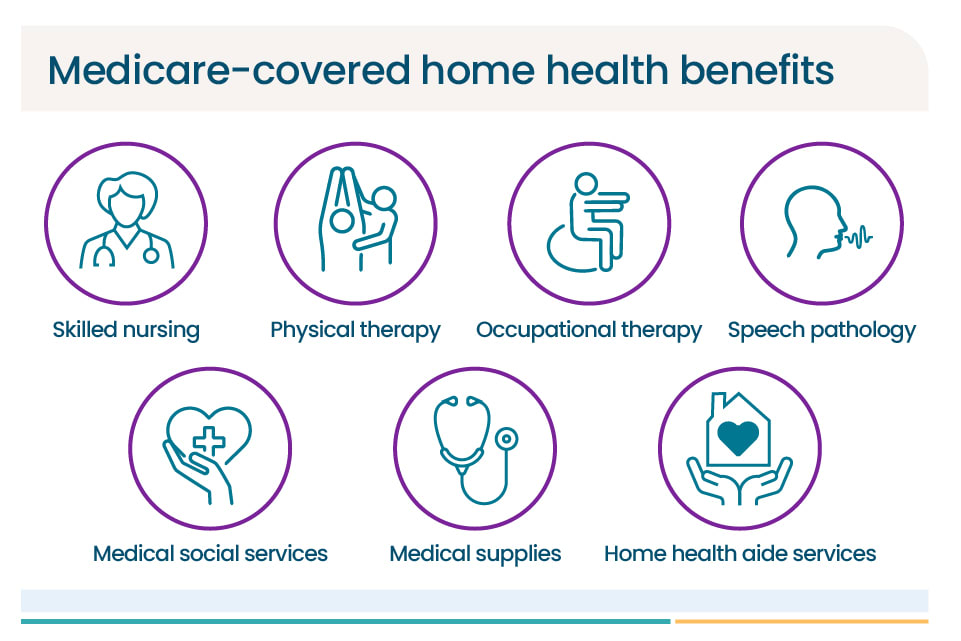
What home health care services are covered by Medicare?
Medicare covers home health care services that are medically reasonable and necessary. These services must be ordered by a doctor and provided by a Medicare-certified home health agency for Medicare to cover them.[01]
Skilled nursing care
Medicare covers part-time or intermittent skilled nursing services. This generally means:
Fewer than 8 hours per day
Fewer than 28 hours per week
Care needed for up to 21 days, with possible extensions
Covered skilled nursing services may include:
Wound and ostomy care
IV medications and injections
Tube feeding
Catheter care
Monitoring of unstable medical conditions
Therapy services
Therapy services must help restore or maintain your loved one’s ability to function after an illness, injury, or hospital stay. Medicare covers:
Physical therapy
Occupational therapy
Speech-language pathology
Home health aide services
Aides are covered only when your loved one also needs skilled care. They can help with activities of daily living (ADLs), such as:
Bathing
Dressing
Eating
Grooming
H3: Medical social services
A medical social worker may be covered when emotional or social concerns affect your loved one’s recovery. These services must be ordered by a doctor and paired with skilled care.
Medical supplies and durable medical equipment (DME)
Medicare covers items such as:[01]
Wound dressings
Catheters
Medically necessary supplies for home health care
For DME — such as walkers, wheelchairs, hospital beds, or oxygen equipment — Medicare usually pays 80%, and you pay 20%.
Let our care assessment guide you
Our free tool provides options, advice, and next steps based on your unique situation.
What home health care services aren’t covered by Medicare?
Medicare won’t cover:
Full-time or 24-hour care at home
Skilled nursing care that’s provided for more than eight hours per day or more than 28 hours per week for more than 21 days
Home health care agencies must give you or your loved one an Advance Beneficiary Notice of Non-coverage (ABN) before providing services or supplies that Medicare likely won’t cover.
How Medicare Parts A and B cover home health care
Medicare can pay for home health care under either Part A or Part B. Part A may apply after a recent hospital stay, while Part B usually covers care that’s medically necessary even without a hospitalization. Knowing which part applies helps you understand your loved one’s coverage and costs.
Coverage Question
Medicare Part A
Medicare Part B
Does it cover home health care?
Yes, but only in limited situations.
Yes, and it’s the most common way home health care is covered.
When does it apply?
After a recent inpatient hospital or skilled nursing facility (SNF) stay, if all home health requirements are met.
When home health care is medically necessary even without a recent hospital stay.
What’s covered?
Same benefit as Part B: skilled nursing, therapies, medical supplies, and short-term personal care tied to skilled services.
Same benefit as Part A.
How much does the patient pay?
$0 for covered home health services; 20% coinsurance for durable medical equipment (DME).
$0 for covered home health services; 20% coinsurance for DME.
Is a hospital stay required?
Yes; generally requires a qualifying inpatient or SNF stay.
No hospital stay required.
What triggers coverage?
Discharge planner or doctor orders home health as part of post-acute recovery.
Doctor certifies homebound status and need for skilled services.
How often is it used?
Less common today.
Most common payer for home health care.
What’s not covered?
Long-term home care, custodial care, supervision, errands, or 24-hour care.
Same exclusions as Part A. Medicare never covers long-term home care alone.
Yes. Medicare Advantage plans, also known as Medicare Part C, must provide the same home health care coverage as Original Medicare.
Some Medicare Advantage plans may offer extra benefits such as:
Transportation
Home safety checks
In-home support services
Meal delivery
Coverage varies by plan, so be sure to check your loved one’s policy.
How long will Medicare pay for home health care?
Medicare covers an initial 60-day episode of home health services.[01]
After that, your loved one’s doctor must review the plan of care and recertify the need for ongoing services.
If skilled care is still needed, Medicare may continue coverage in 30-day increments.
Medicare doesn’t cover long-term care in any setting. Home health care is designed to:
Support recovery
Maintain current functioning
Prevent a condition from getting worse
How many hours of home health care does Medicare cover?
Your loved one’s doctor may approve more care if it’s clear when the need for skilled nursing will end.[01]
Talk with a Senior Living Advisor
Our advisors help 300,000 families each year find the right senior care for their loved ones.
How do I get Medicare to pay for home care?
Medicare will pay for home health care only if your loved one meets all the following requirements:[01]
They must be enrolled in Medicare. To receive home health benefits, they must be enrolled in Medicare Part A and/or Part B.
They’re getting care from a doctor. The services they’re receiving must be part of a care plan that’s reviewed regularly by a physician. Their doctor (or a medical professional working with their doctor) must document that they’ve had face-to-face appointments within certain time frames, and those appointments must be related to the need for home health care.
They require certain health-related services. Medicare home health care services include part-time or intermittent skilled nursing, physical therapy, speech-language pathology services, or occupational therapy.
They’re certified by a doctor as homebound. This means that leaving their house without help is difficult, requires a major effort, or isn’t recommended. However, if someone is considered homebound, they may still leave home for medical treatment or brief and infrequent trips for nonmedical purposes like haircuts, birthday parties, or religious services.
They must get care from a Medicare-certified agency. These agencies not only meet strict federal standards but also qualify for Medicare reimbursement.
Does Medicare cover home health care for dementia?
Medicare may cover home health care for a person living with dementia if they need skilled care. This might include:
If your loved one needs Medicare-covered home health care, start by speaking with their doctor or hospital discharge planner. You can also compare Medicare-certified home health agencies on the Medicare website.
If they need nonmedical home care, A Place for Mom’s Senior Living Advisors can explain available options — including independent living, assisted living, and memory care — all at no cost to families. Advisors can help you find care that fits your loved one’s needs and provides peace of mind for everyone involved.
Families Also Ask
Does Medicare cover custodial care at home?
No. Medicare won’t cover long-term custodial care unless it’s part of a home health plan that includes skilled care.
Do I need to pay a deductible or copay for home health care under Medicare?
No, generally, Medicare covers 100% of all approved home health care costs, but you may need to pay 20% of the Medicare-approved amount for any durable medical equipment.
Can I choose my own home health care agency when paying through Medicare?
Susanna Guzman is a professional writer and content executive with 30 years of experience in medical publishing, digital strategy, nonprofit leadership, and health information technology. She has written for familydoctor.org, Mayo Clinic, March of Dimes, and Forbes Inc., and has advised Fortune 500 companies on their content strategy and operations. Susanna is committed to creating content that honors the covenant between patients and their providers.
Ashley Huntsberry-Lett is the Manager of Content Strategy at A Place for Mom. She has over a decade of experience researching, writing, and editing content for family caregivers on topics like senior health conditions, burnout, long-term care options and costs, estate planning, VA benefits, and Medicaid eligibility. Ashley has also moderated AgingCare.com’s popular Caregiver Forum since 2018. She holds a bachelor's degree in English and a master's degree in mass communication from the University of Florida.
The information contained on this page is for informational purposes only and is not intended to constitute medical, legal or financial advice or create a professional relationship between A Place for Mom and the reader. Always seek the advice of your health care provider, attorney or financial advisor with respect to any particular matter, and do not act or refrain from acting on the basis of anything you have read on this site. Links to third-party websites are only for the convenience of the reader; A Place for Mom does not endorse the contents of the third-party sites.