The State of Caregiving
Caregivers navigate changing needs and difficult decisions. New survey findings reveal what’s shifting — and where families need more support.
READ FULL REPORT
2025 REPORT • A PLACE FOR MOM

This report reveals how Americans navigate the search for professional senior care, drawing on the self-reported behaviors and priorities of more than 1,000 family caregivers. Readers will find unique data-driven insights into who needs care, who provides it, what prompts families to begin searching, and the emotional and financial challenges that shape decision-making.
Family caregivers often underestimate how quickly they will need to make care decisions. Many expect months or years to plan, but the reality is that more than two-thirds of those who secure senior care search for 60 days or less. While most families say their search for in-home care or senior living begins due to gradually increasing care needs, urgent events such as falls often accelerate the process. This misalignment leads to regret, with more than half of caregivers wishing they had started planning sooner.
Affordability of senior care is cited as the leading concern by most families. Nearly half rely on out-of-pocket funds to finance professional care, while others turn to federal benefit programs or private insurance coverage. Most families describe understanding payment options as overwhelming. Balancing cost and care often requires tough tradeoffs.
More than three-quarters of caregivers feel that families need more support during their search for professional care. Families are often left to make life-altering care decisions with limited information and little guidance. Without a clear understanding of their options, many find the process confusing and overwhelming.
Access the PDF of the report.
When caregivers begin their search for professional senior care, the loved one in need is most often a woman in her late seventies to early eighties. In fact, more than six in ten care recipients are women. The largest share — 37% — is between the ages of 75 and 84, with another 22% ages 85 to 94. Most care recipients (83%) live within a 30-minute drive of their family caregiver, underscoring that caring for aging relatives often begins close to home.
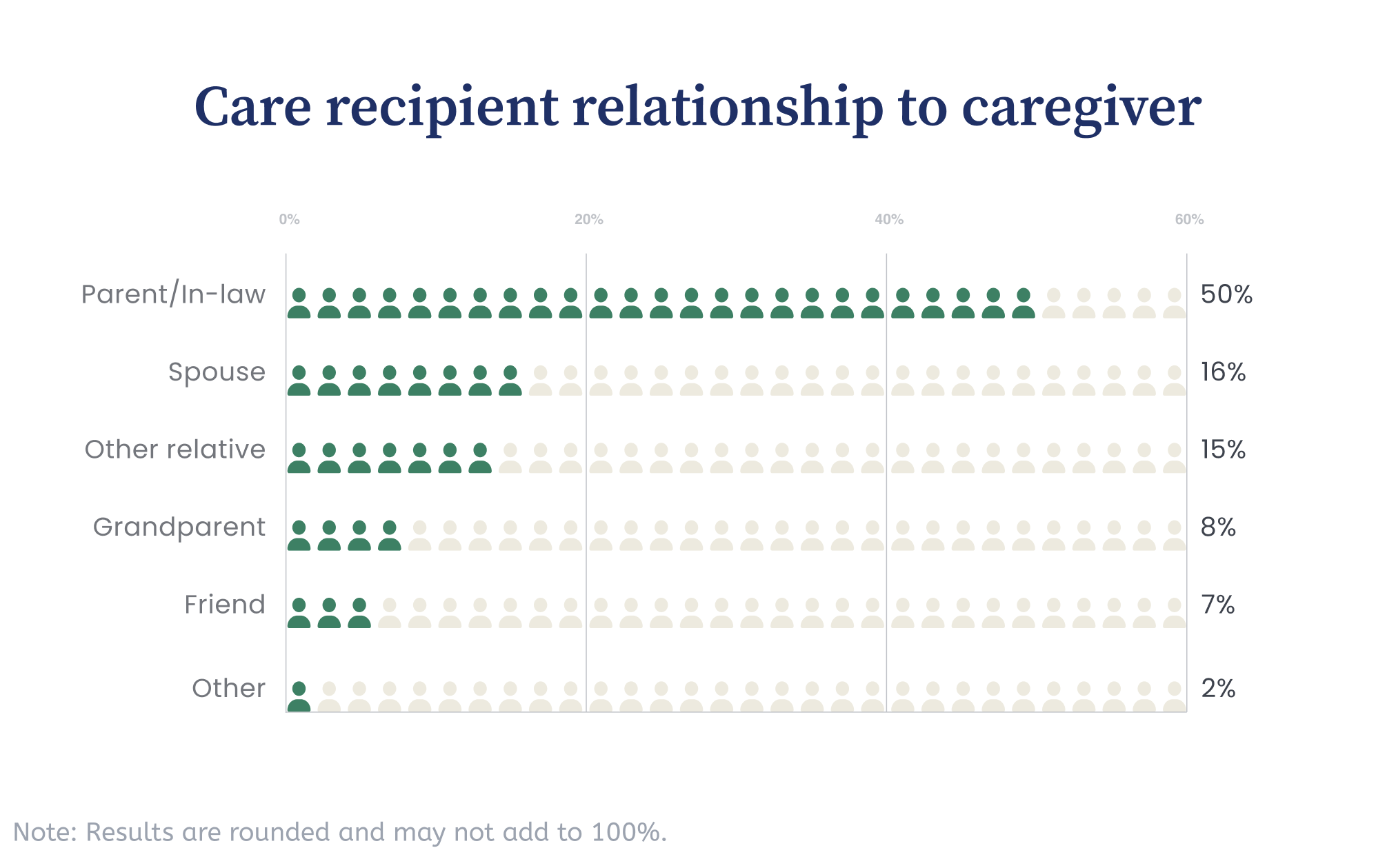
Two-thirds of family caregivers (66%) are women, reflecting broader trends in which women disproportionately provide unpaid care. In many cases, these same women also take on the complex task of arranging professional care, with adult daughters and daughters-in-law most often leading the search.

Family dynamics, proximity, employment status, and household responsibilities frequently shape who leads the senior care search. About one-third of caregivers (34%) are raising children, often teenagers. This means that many are part of the sandwich generation, simultaneously supporting both an aging parent and dependent children.

Age plays a key role as well. Nearly half (45%) of all caregivers are ages 60 or older, balancing their own aging needs while supporting an elderly relative.
The typical caregiver searching for professional support has already provided years of care: 59% have been caring for their loved one for more than three years. Many manage alone — 34% report having no other help. Another 26% rely on their spouse, siblings (17%), or other family members (21%).
“My sister sometimes helps with things, but I would say it’s more of an 80%-20% split. I guess the primary [caregiver role] fell to me, with me being the oldest of the children.”
Nearly three-quarters of caregivers (73%) say their search for professional care was prompted by a gradual need rather than a specific trigger.

Age-related changes can unfold so slowly that many caregivers don’t realize how much their role has grown — or how much stress they’re under — until they find themselves unable to manage their loved one’s care. This slow shift is sometimes described as caregiver creep. Over time, helping with errands, preparing meals, or checking in daily can expand into providing round-the-clock support with personal care, mobility, or medical needs. Caregivers often begin the search for home care or senior living when their loved one’s existing care plan becomes unsustainable.
“Dad fell twice in one day, and the falls were becoming more frequent. Forming words had become more difficult, and his incontinence had progressed. I’d bring his clean laundry back to him and he’d ask me if he’d had an accident — he didn’t remember having one. As I saw that my dad’s mental processing was becoming more of a challenge, I knew I wouldn’t be able to care for him myself.”
On the other hand, 24% of caregivers report a specific event prompted their search for professional support. The most common triggers are a loved one’s inability to perform daily activities like bathing and dressing (55%) and mobility challenges (44%). Dementia symptoms, including memory loss, also prompt many searches (38%). Acute health events such as falls can cause or exacerbate these factors and often play a major role in urgent care decisions.

These findings show that caregivers are typically responding to multiple pressures —physical, cognitive, and emotional — that converge to make additional care necessary.
Among caregivers who are actively exploring options or haven’t started searching yet, 33% anticipate needing to find care for their loved one within a few months to a year, while 44% think they are more than a year away from making a care decision. However, only 10% of caregivers who already found senior care described their search as lasting more than a year.

Caregivers and seniors tend to overestimate how much time they will have to search for senior care. While many families recognize that various care options exist and that important decisions lie ahead, planning does not feel urgent until circumstances change.
Comparing timelines from respondents who already found care with those who were still early in their search reveals a clear mismatch between care planning expectations and real-world urgency.
This miscalculation often leads to added stress, hurried decisions, and regret. Over half (54%) of all caregivers surveyed wish they had started making a senior care plan sooner. That feeling is especially strong among those with recent experience: 77% of those currently searching agree that they should have begun earlier.
“I have been a caregiver to my mother over the past year. She experienced a sudden change in her health, which led to multiple emergency surgeries, long hospital stays, rehab, and home care. It has been a challenging experience mentally, emotionally, and physically, as this was completely unexpected and unplanned.”
Most caregivers (84%) value their loved one’s independence when seeking professional care. When searching, they express a strong preference for in-home care (53%) over senior living (33%). However, more than one-third find it difficult to know what level of care is best for their loved one, and 41% aren’t sure what they’re looking for in a senior care experience.
This aligns with other survey data that most caregivers navigate the search on their own and find the process confusing and overwhelming. Caregivers are forming preferences without important guidance about how various options and needs align, what to look for, or how to evaluate providers.

“I have so many questions and I don’t know where to start, who to talk to, what to search, etc. It gives me a headache to even think about it.”
When families begin evaluating senior care options, two themes consistently rise to the top: quality of care and value for cost.
For those searching for senior living, the quality and friendliness of staff (73%) and the type of care provided (71%) are the most important considerations. Caregivers are equally attentive to overall cost (70%) and the range of services offered (68%), reflecting the need to balance care quality with affordability.
Environment also matters. Factors like room quality, facility reputation, and proximity to friends and family weigh heavily in decision-making. Amenities like dining options, social opportunities, and activities — each cited by over half of respondents — play a supporting but meaningful role in senior living decisions.

Families searching for home care also focus on both the quality of the relationship with the aides and the cost of care. Nearly three-quarters (73%) cite comfort with the professional caregiver as a priority, particularly since many caregiving tasks — such as bathing, dressing, or offering reassurance during memory lapses — are deeply personal. Similarly to those seeking senior living, they also cite quality and friendliness of staff (72%) as a top consideration along with overall cost (67%).
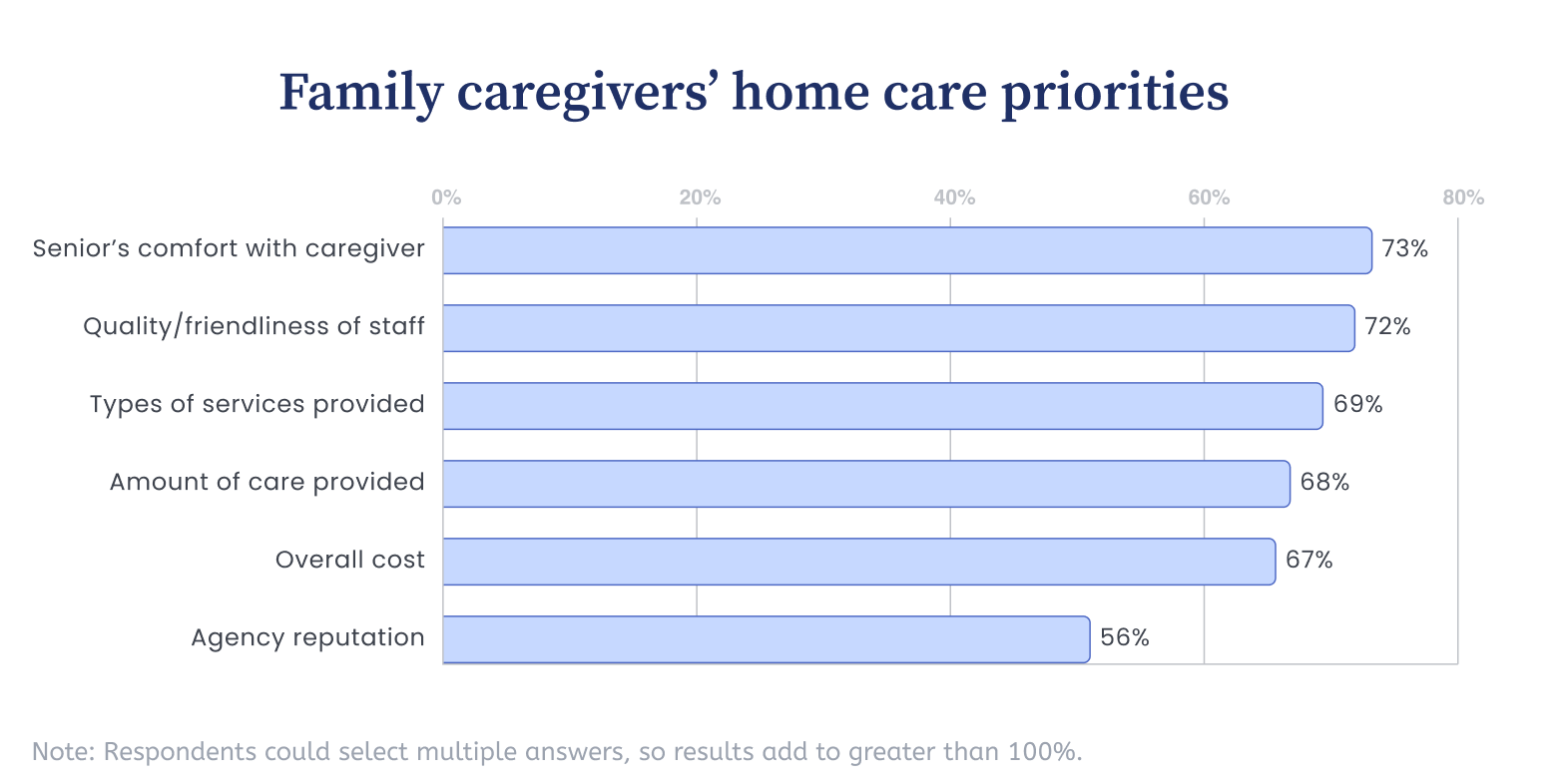
Together, these findings show that families weigh both emotional priorities, such as comfort, trust, and staff relationships, and practical concerns, such as services, cost, and reputation, when selecting senior care.
High costs are caregivers’ number one concern about both senior living (64%) and in-home care (72%). More than three quarters (78%) say they want to make the best choice possible but can only afford so much, and 70% admit that understanding how to finance senior care feels overwhelming.

Affordability is a pressing concern, yet many families are willing to make tough financial decisions to support their loved one. Over half said they will choose whatever option is best regardless of price, and nearly half would prioritize their loved one’s well-being above all else — even if cost is a strain.

“My biggest fear is running out of resources and being unable to financially and emotionally support my mom for the duration of her lifespan. […] I do not want her to ever go without the care she needs. She is profoundly disabled, and I make sure she receives only the best care because I love her[…]”
Nearly half (46%) of families plan to pay for professional senior care out of pocket, drawing on a combination of sources like monthly income, savings, investments, retirement benefits, home equity, and contributions from family members. Because costs often extend over many years, families must typically blend multiple funding sources that may shift as a senior’s health, care needs, and financial situation evolve.
Private insurance plays a role for some seniors (37%), but only specialized long-term care policies — or other products with long-term care benefits — cover extended care needs. Medicaid is another option, with a third of caregivers expecting to rely on it at some point. However, many seniors must spend down their assets and income to meet eligibility requirements, meaning families often face out-of-pocket costs before qualifying. Senior veterans and their surviving spouses may also be able to use VA programs or benefits, adding another layer of potential support.

Most family caregivers found, were searching for, or plan to search for senior care in the South (39%) or the Midwest (22%) regions of the United States. The Northeast and West each account for nearly one-fifth of searches (19%).
These trends align with the sizable populations of older people in these regions, particularly in southern states like Florida, Texas, and North Carolina and midwestern states like Ohio, Illinois, and Michigan.

Seventy-eight percent of caregivers look for senior care in suburban or urban areas, while only one-fifth seek care in rural areas.
As with other aspects of the search for senior care, balance is key. Families look for the right mix of affordability, availability, amenities, and proximity when choosing a location. Most caregivers search in suburban areas because they typically offer the best balance of these factors. Urban areas tend to be more expensive for senior care, while rural areas have fewer care providers to choose from.
The search for senior care is widely seen as difficult — 88% agree families need more guidance and support navigating it. About one-third (34%) of family caregivers report taking a do-it-yourself approach, with 47% relying on conversations with health care professionals or friends and family to gather advice and recommendations. Online searches are also common.
Doctors and other health workers can provide medical insight. However, they may not always be positioned to guide families through understanding care types, comparing providers, evaluating costs and payment options, or managing the logistics of interviewing and hiring home care or touring and transitioning to a senior living community.
“It seems like I and everyone else on this journey [are] often flying blind and learning as we go.”
Caregivers who are already stretched emotionally, financially, and logistically are often left to make life-changing decisions about senior care with limited information and little support. They seek guidance to help them see the full picture, weigh their options, and make confident care decisions for their aging loved ones.
This report is based on an online quantitative survey commissioned by A Place for Mom and conducted by Hello Possum in February 2025. The study included 1,104 surveys of a representative sample of family caregivers across the United States.
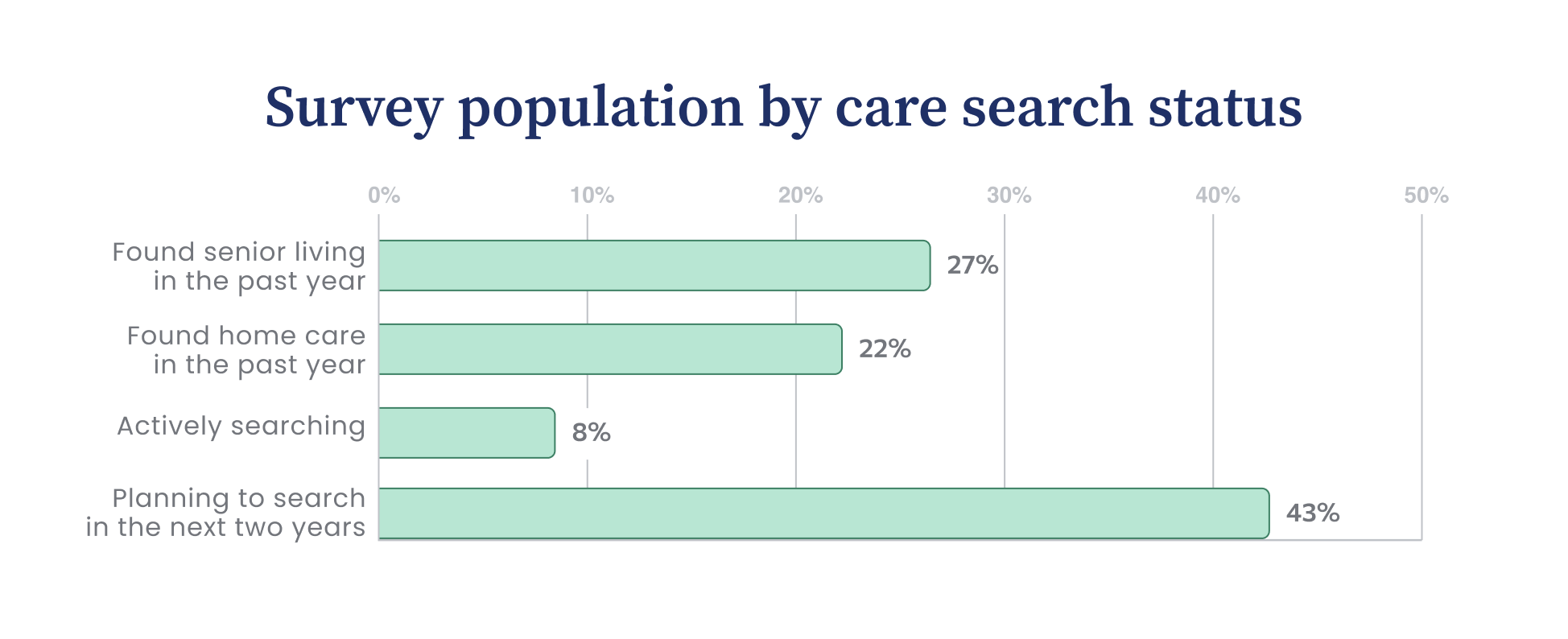
Of these caregivers, roughly half moved an aging loved one into a senior living community or hired home care for a loved one in the past year. The other half of respondents were either actively looking for senior care at the time of the survey or planned to look for senior care in the next two years.
Many families underestimate how quickly care needs can change or feel unsure where to start navigating complex options and costs. Others may delay elder care planning because it’s emotionally difficult to confront a loved one’s aging or loss of independence.
Families often struggle with managing financial constraints, understanding the range of care options, and assessing the quality of senior care options. Emotional stress and time pressures also make it difficult to make confident, informed decisions.
Key factors include the senior’s care needs, level of social engagement desired, and budget. Home care may be best for seniors who need limited or part-time care. Senior living provides round-the-clock access to professional care, social activities, and community amenities — making it ideal for those who need consistent, long-term support. Families also weigh their loved one’s preferences, independence, and access to professional care services.
Caregivers navigate changing needs and difficult decisions. New survey findings reveal what’s shifting — and where families need more support.
READ FULL REPORT
Explore A Place for Mom's report to learn about the costs of assisted living, memory care, home care, and more.
READ FULL REPORT